Life of Pi
Written by: Rayyan Aamir | April 27, 2024
Author: Yann Martel
Genre: Adventure, Survival, Drama
Published: 2001
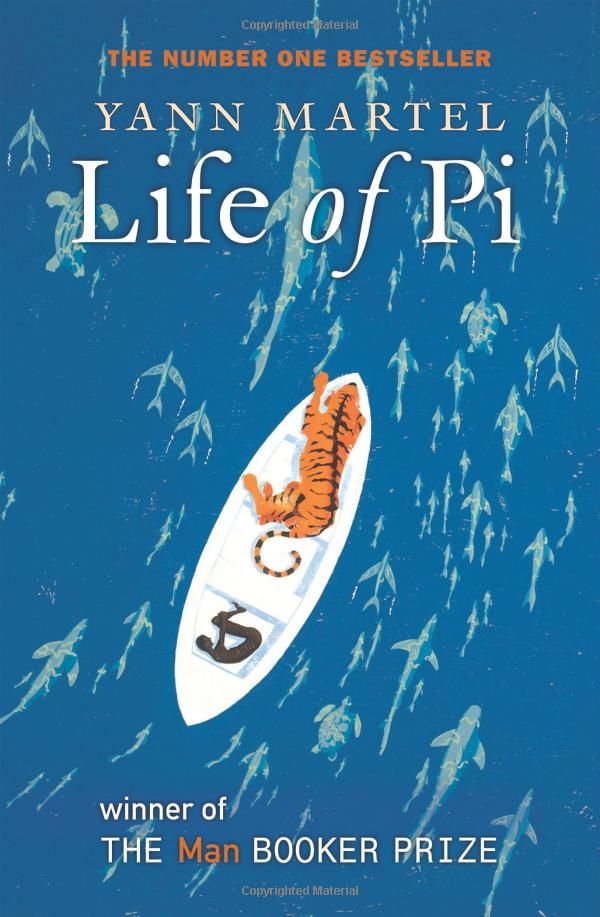
Life of Pi is a remarkable story that explores the boundaries of human endurance, faith, and storytelling. The novel follows Piscine Molitor Patel (Pi), a boy who survives a shipwreck and drifts in the Pacific Ocean on a lifeboat with a Bengal tiger named Richard Parker. Yann Martel's masterful narrative takes readers on a journey of survival against impossible odds while reflecting on themes of spirituality, human connection, and the power of belief. This is a novel that's split into three parts, but before we can get into the big picture, there's a little note from the author that pretty much can be summarized as questioning the truth and what really composes a lie or a reality.
We then begin part one, which starts in the sixties. Our main character is Pi, and he's the son of a zoo owner in Pondicherry. He's very reflective on the nature of zoos and how they keep animals caged, and he also describes how his classmates make fun of his name and how he came to be known simply as Pi.
Pi is obviously a very mathematical name, and explains that. We then learn about his experiences with religion, as he meets people of different religions and decides to experiment with them all. When he is fourteen, he decides he is going to be a Hindu, Christian, and Muslim, despite his parents objecting to the fact and everyone telling him that you can't be all three at once.
He also brings up Richard Parker, the Bengal tiger in the zoo; his father explains to his brother and he how they are such dangerous animals. 1976 hits, and Indira Gandhi declares The Emergency. The family decides to leave India for Canada, selling the animals at the zoo to places all over the world, whether in Asia or the United States. In the summer of 1977, they board a Japanese freighter, which is all they can afford while transporting the animals.
When right outside of Manila, Pi wakes up in the middle of the night and leaves behind his family, which is how he survives the ship sinking. A sailor picks him up and throws him onto the lifeboat, which contains a zebra, Orange Juice the orangutan, a hyena, and Richard Parker.
As the days go on, the animals get more vicious. The hyena kills and eats the zebra, and when Orange Juice decides its had enough, she attacks the hyena. The hyena overpowers Orange Juice and kills her, then Richard Parker, who has been hiding on the boat, goes and kills the hyena.
All that's left on this boat are Pi and Richard Parker. Pi decides to make a raft to live on, and he eventually asserts himself as the dominant animal on this structure, making Richard Parker submissive. Pi slowly goes delirious as they drift along the Pacific Ocean, and at one point he's hallucinating and thinks Richard Parker is speaking to him. Turns out there's another person on board all this time, a French guy, and Richard Parker kills him before the guy eats Pi.
Eventually, they come across a floating island full of meerkats. They stay there for a bit, but when Pi realizes the plant life eats flesh/meat, he packs up shop and leaves.
227 days after the ship sinks, the two wash up on Mexico. Richard Parker flees into the jungle, and Pi is rescued from some locals. Two officials in part three come from the Japanese Ministry of Transport to figure out what happened here, and Pi recalls his tale from the hospital. They don't believe him, so Pi offers an alternative where the zebra is a Taiwanese sailor, the cook is the hyena, and Orange Juice is his mother. The cook uses the sailor's leg as fish bait, the sailor dies, and the cook kills Pi's mother. The cook is then killed by Pi, who eats him.
The investigators find this fascinating and connect the dots between the animals and Pi's story. Pi says neither can be proven as right, but the cause of the shipwreck is unknown. He asks them what story they prefer, then thanks them. The investigators file a report with the first story.
Overall Thoughts
This is an extremely philosophical novel, and there are a lot of dimensions to it when it comes to understanding how this impacts the viewing of the story and its themes.
Pi obviously is not a “normal” kid from the way he names himself after an abstract math concept and then subscribes to three different religions at once (I use normal lightly here, because nothing truly ever is normal), and his reflections show that strange level of maturity.
I think there's a lot to take away from this book though in our own lives, especially when we consider the stories we tell ourselves and what makes them true.
We also take a good while before we even get to the shipwreck and what the novel is best known for, but we need that context to have the novel make such an impact.
Comments